

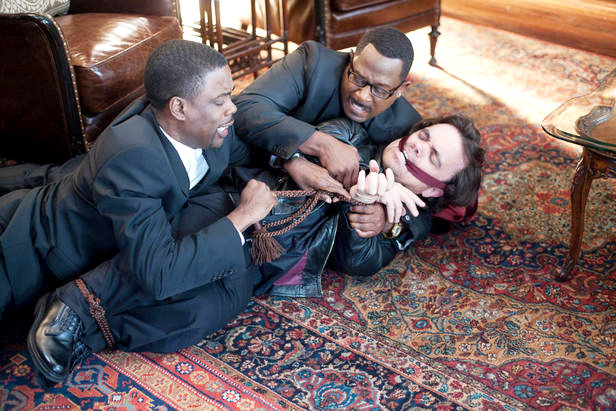
To be fair to Death at a Funeral, I was already familiar with the 2007 British version that spawned Neil LaBute's re-imagining. It's not an groundbreaking movie, but it's a smart and swift comedy that deftly accomplishes its mission. It does it with the sort of subtlety that one expects from a British comedy. The remake does an equally admirable job, but it goes about it in a different way. LaBute's Death at a Funeral is not smart or subtle. It's a very American comedy. It bucks witty dialogue for sight gags and slapstick. That's not a criticism. Death at a Funeral remains a fairly solid comedy despite a significant change in the tone of the film. It's surprisingly faithful to the original given the three-year disparity in their releases, but while dialogue carries the original, character performances carries the second.
The premise of both films is fairly basic and self-contained. The family patriarch passes away, and family and friends come in from all over to pay their respects. Aaron (Chris Rock) and his wife Michelle (Regina Hall) live at home with Aaron's mother (Loretta Devine), who is grieving her husband while taking every opportunity to bemoan Aaron and Michelle's inability to conceive a child. Aaron is nervous about having to give the eulogy despite the fact that his younger brother, Ryan (Martin Lawrence), is an author. Aaron is jealous of his younger brother's success, especially since he has written a manuscript that he won't let anyone read because of his self-doubt, and the preferential treatment that his mother gives him despite Ryan's immaturity. Meanwhile, Elaine (Zoe Saldana) and Oscar (James Marsden) stop to pick up Elaine's brother, Jeff (Columbus Short). Oscar is nervous about being around Elaine and Jeff's family because he thinks they, and especially Elaine's father (Ron Glass), don't like him. Elaine tries to calm him down by giving him one of Jeff's valiums that she finds laying around, except we quickly learn that the valium is really acid. Elsewhere, we meet Norman (Tracy Morgan) and Derek (Luke Wilson), who are picking up Uncle Russell (Danny Glover) before making their way to the funeral. Derek is still pining over Elaine, and plans to use the funeral as an opportunity to get her back. Norman is concerned about a rash on his wrist and with keeping Uncle Russell in line. Uncle Russell is just a mean, abusive old man. All of that would be plenty complicated on its own, but a mysterious midget named Frank (Peter Dinklage, playing the same character he did in the original) complicates things by showing Aaron pictures of him and Aaron's father being intimate. He wants $30,000, or he's going to show the pictures to Aaron's mother.
At times, the story bogs down and becomes so convoluted that I couldn't help but shake my head at it. Essentially, it's the same story that the original has. It even recycles some of the dialogue. I can't exactly put my finger on why, but the story feels much more difficult to follow this time around. It becomes difficult at times remembering why certain characters are doing the things they are, or how they got to the places they get to despite a very small setting and fairly shallow characters. That speaks more to the direction than anything else. Frank Oz is adept at managing the large ensemble cast to make it seem like the chaotic nature of the story isn't spinning out of control. Neil LaBute doesn't have that talent. The large cast seems to be a detriment in this movie. I watched the original again after seeing the remake to make sure I wasn't imagining things, but sure enough, I felt like each character was essential to the plot. In LaBute's version, I feel like characters are wasted, pulled off poorly, or at times dragging down the pace. I'm not sure what Norman and Derek really bring to this movie, aside from some unneeded comic relief and a fairly unconvincing dilemma for Elaine. Maybe it would've been more effective to know why Derek, a seemingly good-looking and successful man, can't get past Elaine when Elaine has been nothing but direct with him, but I doubt it. Even at that level, his character seems unnecessary. We have enough conflict for Elaine with her dealing with her disapproving father and her boyfriend's acid trip without needing Derek's issues thrown in. Norman, meanwhile, is supposed to be another slapstick character, and it's not needed at all. James Marsden as Oscar provides more than enough slapstick humor for this movie by himself. Norman's not necessary. It gives us another vehicle for Tracy Morgan to act like Tracy Morgan in, but that's about it. Between that and the gross-out joke that Norman participates in, I could've done just fine without him.
That's not to say the acting in this movie is weak. This movie's strength is from its performances. Not all of them are good performances, but the ones that are completely makes up for the ones that aren't. I've already covered Tracy Morgan and Luke Wilson (who is definitely not at his best in this movie), so I'll just get the other mediocre ones out of the way. Martin Lawrence drags down many of the scenes that he's in. I'm not sure how he manages to do this, but it's palpable. The better performances in this movie occur with his character out of the scene. Most of his character's dialogue is fairly cliche, but Martin Lawrence manages to make it feel even more trite when he says it. Chris Rock isn't given much of an opportunity in the movie to be himself. Death at a Funeral casts his character as the straight man, which is necessary but not exactly Rock's forte. He's at his best when he's unleashed and allowed to gravitate more towards his stage persona. In this movie, he's supposed to be the emotional center of the chaos, and that requires more depth as an actor than Rock has shown in the past, or shows in this movie. Columbus Short is almost completely forgettable. And Loretta Devine doesn't seem to have any other tone in her voice than a long, drawn-out sigh. On the positive side, Zoe Saldana is terrific as Elaine. Outside of Aaron, Elaine's character carries most of the emotional core of the movie, and she pulls it off well. Her emotions and reactions are believable, her anger at Derek's character never seems silly or over the top, and her exasperation and concern for Oscar is never stiff or unbelievable. It's easy to feel saturated by Saldana given how many movies she's appeared in lately, but she really sinks into this character despite the character's limited depth. If Avatar and Star Trek hadn't already convinced me of her talent, this movie would've sealed it. Peter Dinklage does more with the material in this film than he did with the original. Maybe it's because of the emphasis on physical humor in this one, but whatever it is, he shines in his role. He brings a level of seriousness to his character's almost ridiculous presence and nerve that really cinches that character for the audience. Danny Glover was so hilarious and convincing in his role that I will refuse to believe that he isn't a mean, grouchy old man until I'm shown proof to the contrary. Regina Hall is given two emotions to work between: anger and sympathy. She manages to shift between them quickly, but it never feels rushed or sudden. Ron Glass was an excellent choice for a disapproving father. While all those performances are great, James Marsden carries this movie. It's not completely out of left field considering how hilarious he was in Sex Drive. In Death at a Funeral his character, Oscar, provides most of the physical humor. He spends everything but the first 15 minutes of the film on the mother of all acid trips, and he never breaks that level of comedic intensity. Marsden never feels like he's going beyond the tone of the film. His performance never feels forced, and it never feels like he's desperately trying to be the funniest guy in the room. Considering the level of comedic talent involved in this film, the fact that Marsden is consistently the funniest actor on screen speaks to his talent. Alan Tudyk plays Oscar's equivalent in the British version. Tudyk is a fantastic actor and an unappreciated comic presence in general, but 2007's Death at a Funeral is probably his finest performance. And Marsden is significantly better in the remake. He's worth the price of admission alone.
Despite a couple of clunky performances and characters that are shallow to the point that I could summarize them with a one or two word emotion, Death at a Funeral is an effective comedy. Like its predecessor, it's nothing new to the field and it definitely could have been managed better, but as comedies go, it's a solid entry. Depending on the style of humor you like, you might even like it better than the original. Even though I prefer more subtle, high-brow humor, I spent the better part of an hour and a half laughing. It's hard to ask more than that from a comedy.

No comments:
Post a Comment